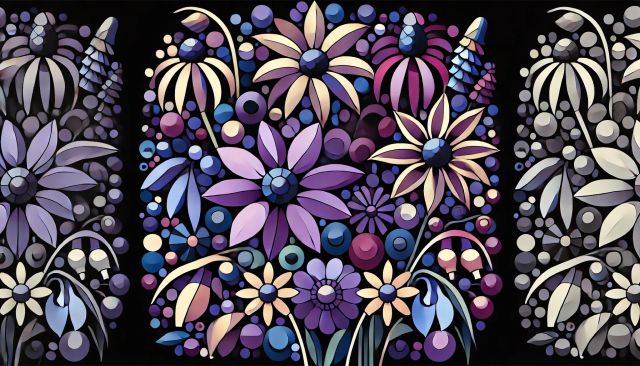
Cubist Influence on Michigan's Native Wildflowers Art Print
Immerse yourself in the enthralling visual symphony of cubic shapes and vivid hues with this artistic interpretation of Michigan's native wildflowers. Rendered in a compelling Cubist style, this image reimagines the natural beauty of purple coneflower, trillium, black-eyed Susan, and other indigenous florae through geometric fragmentation and reorganization. Each flower, while abstract, retains a semblance of its organic essence, communicated through bursts of purple, blue, and yellow, harmonizing against a dark, contrasting backdrop. This piece both celebrates the diversity of Michigan's botanical landscape and challenges traditional perceptions of floral art, making it a stunning addition to any collection of fine art prints or home decor. The black background not only intensifies the floral colors but also adds a modern touch that makes the artwork suitable for various interiors. Perfect for those who appreciate a modern twist on botanical themes, this artwork invites viewers to explore the complexities of nature through the lens of contemporary art. *** About Cubist Art: Cubism originated in the early 20th century, led by artists Pablo Picasso and Georges Braque. It revolutionized European painting and sculpture by bringing a novel concept of breaking objects into fragments and reassembling them abstractly, often depicting the subject from multiple viewpoints. This style emphasizes flat, two-dimensional surfaces, challenging the traditional techniques of perspective, modeling, and foreshortening. Cubism has had a profound influence on other forms of art, including literature and architecture, making it a pivotal movement in the history of modern art.
Image ID: 74210
|

 Canvas Prints
 Fine Art Printing
 Framed Prints
 Plaque Mounting
 Fabric Printing
 Metal & Wood Prints
 Plexi Face Mount
 Print & Dry Mounting
 Cityscape Prints
 Greeting Cards
 Classical Art Prints
 AGP Galleries

 Custom Picture Frames
 Canvas Floaters
 Wood Frames
 Metal Frames
 Canvas Transfer
 Custom Stretcher Frames
 Custom cut MatBoards
 Custom Plexi Cuts
 Custom Size Boards
 Pre-Cut Boards
 Framing Hardware

 Upload Your Photos
 Ideas Gallery
 How it works?
  Artwork Scanning
 Laser Engraving & Cut
 Coffee Mug Prints
 Acrylic Blocks
 T-shirt Prints
 Handmade Oil Paintings
 All Products
 Custom Artist Canvas
 Custom Size Wood Panels
 Canvas Stretching Services
 Resources
 DoveTail Guide
 Aluminum Bars
 Wood Panels
 Stretcher Bars
 Easels & Display
 Resin Coatings
 Cork Rolls/Sheets
 Resin On Canvas
 Price Calculator
 Gift Certificates
 Collages on Canvas
 Word Cloud Design
 Photo Mosaics
 Image Effects
 FAQs
FAQs Pro Accounts
 Artist Gallery Program
 Corporate Art
 Contact KeenART
 Turnaround time
 Shipping
 Rush Orders